

What is Accelerated Stability Testing?
Accelerated stability testing simulates harsh environmental conditions such as high temperature and humidity to enable manufacturers to predict the behavior of the product in the long term. It is also knows as accelerated shelf life testing due to the fact that it is essential in products with long shelf lives.
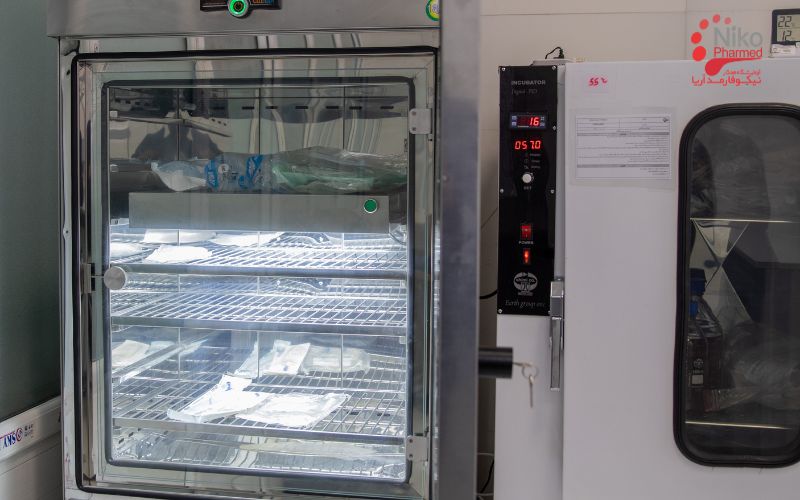
Accelerated stability testing involves placing the product in a controlled chamber; usually, this is done at 40°C with a relative humidity of 75%. Samples are drawn at fixed intervals, normally at 0, 1, and 3 months, and analyzed for various parameters. Tests can be carried out by referring to international standards such as ICH Q1A(R2). For products sterilized with gaseous methods, combining accelerated stability studies with our Residual Ethylene Oxide Gas Testing guarantees both chemical safety and long‑term stability.
Test Durations in Accelerated Stability Testing
1-Year Accelerated Stability Test
This method assesses the behavior of the product by simulating a 1-year shelf life. Samples are drawn at 0, 1, and 3 months, with tests conducted at each stage. The 3-month data point provides the final stage and prediction of product stability under harsh conditions for one year.
2-Year Accelerated Stability Test
The testing for a simulated 2-year shelf life is at 0, 1, 3, and 6-month intervals; the 6-month point, however, is considered a final test. Data from such intervals help predict how the product will perform over two years under stressful conditions.
3-Year Accelerated Stability Test
This approach involves more frequent sampling at 0, 1, 3, 6, and 9 months, with additional points added for each extra year of stability being tested. These findings will predict the long-term stability of the product over a three-year period.
For more information about accelerated stability testing, feel free to contact Nikopharmed.
What tests are Conducted at Each Stage of Stability Test?
For each point of sampling, for example, 0, 1, 3 months, the samples are subjected to various tests:
Physical and chemical tests: These include the evaluation of changes in appearance, color, odor, taste, viscosity, among others.
Microbiological Tests: The testing of microbial growth to ensure that the product remains free from contamination.
What is the Purpose of Accelerated Stability Testing?
- Product Shelf Life Prediction: This allows companies to estimate the time for which a product will continue being valid and safe for use before it is sold to the consumer.
- Determination of Optimal Storage Conditions: The data is used in determining the ideal conditions which best preserve the product’s quality.
- Degradation factor identification: It shows which factor-like light, temperature, humidity, or chemical reactions-most affects product quality over time.
- Safety and Efficacy: In the case of pharmaceuticals, in particular, it is important that products remain effective and free of injurious compounds.
What Are Benefits of Accelerated Stability Testing?
Accelerated stability testing offers several benefits, including reduced time to determine shelf life, as it uses accelerated conditions to quickly assess a product’s longevity. This also leads to lower costs, as faster testing facilitates quicker market entry and reduces storage expenses. Additionally, it allows for the early detection of potential issues, such as formulation or packaging problems, enabling timely corrections before they become major concerns.
Accelerated stability testing is necessary to predict the performance of products under different conditions. By analyzing data obtained from the tests, manufacturers are assured about their product’s quality, shelf life, and safety. However, for even greater accuracy, the results from this method must be checked against data obtained from real-time stability testing.
What is Real Time Stability Testing?
In real-time stability testing, the product is stored under normal, realistic conditions to assess its durability and performance over time. Whereas accelerated testing involves simulated environmental conditions that are more extreme, this type of testing better represents the actual condition of the product over the expected life of the product in the marketplace.
Features of Real-Time Stability Testing
Natural Conditions: The product is stored at normal temperatures-usually 25°C-and humidity levels, which are near the normal storage conditions of consumers.
Longer Testing Period: While accelerated tests are much faster, real-time stability testing usually takes several months or even years, wherein the samples are periodically tested.
More accurate results: The stored product is in real-life conditions, hence the findings are closer to reality in the market.
Accelerated Packaging Stability Testing
Packaging stability testing refers to the methodologies that allow a product’s packaging to be tested for protection against basic environmental factors such as temperature, humidity, light, and pressure. Accelerated packaging tests simulate harsh conditions to predict the performance of packaging over time.
This method involves placing the packaging in a chamber at 55°C and comparing the results with real-world data. Every 40-day period in the chamber corresponds to one year of storage under normal conditions, thus providing a fast overview of the durability of packaging over long periods.
Medical device package stability testing
Medical device package stability testing is a key process that ensures the safety and effectiveness of sterilized medical devices. It evaluates how well medical device packaging will maintain its integrity and performance over specific period of time under specified conditions. This test includes:
Strength Testing: There are various kinds of physical stress-packaging may be confronted with during transit or storage, including pressure, impact, and stretching.
Seal Integrity Testing: This ensures that the packaging seals correctly to avoid leaks or contamination.
Leak Detection in Medical Packaging: Specialized tests to detect minute leaks in porous medical packaging by color penetration or bubble detection.
For formulations including preservatives or antimicrobial agents, Antimicrobial Effectiveness Testing (AET) complements stability tests by verifying that preservative systems remain effective over time under storage conditions
Accelerated Stability Testing Services at Nikopharmed
Nikopharmed provides specialized accelerated stability testing for pharmaceuticals, cosmetics, and packaging products, ensuring that they meet the highest quality standards. Our testing services help predict the longevity, quality, and performance of products and packaging in various environmental conditions.
Our real-time stability testing services are also available for more accurate predictions regarding product lifespan and storage conditions. By combining these testing methods, we ensure that your product remains safe, effective, and compliant with international standards throughout its lifecycle.
For more information about accelerated stability testing, feel free to contact Nikopharmed.