
What is aflatoxin testing?
Aflatoxin testing is a specialized method in analytical chemistry used to identify and quantify aflatoxins, which are toxic compounds produced by certain Aspergillus fungi in food and animal feed. The test can be done by techniques such as High-Performance Liquid Chromatography (HPLC) , Thin-Layer Chromatography, or Enzyme-Linked Immunosorbent Assay. The food sample will undergo an extraction and purification process to separate aflatoxins and their concentration is measured thereafter by the chosen methods. This test must be very accurate, sensitive, and it should detect trace levels of aflatoxin, since they are toxic to human and animal health even at low levels.
For a free consultation and services, contact NikoPharmed
Importance of Aflatoxin Testing
Aflatoxins are some highly dangerous toxins produced under warm and humid conditions by fungi such as Aspergillus. Such toxins may be carried through basic food items, including but not limited to corn, peanuts, and dried fruits, including animal feed. Minimal intake of such contaminated products can lead to severe liver damage, immune system weakening, and long-term exposure might result in cancer, especially liver cancer. Testing for aflatoxins hence performs identification and removal of contaminated products from the food chain, which is crucially important to public health protection.
This test is also a necessity in terms of fulfilling the standards set by different organizations and national regulations regarding food safety. Products of agricultural origin with levels of aflatoxins higher than the permissible limits are not only prohibited for sale in local markets but are also disallowed for export. These tests are also important in ensuring the health of livestock and poultry, enhancing the quality of agricultural products, and upholding the credibility of producers in the market.
At NikoPharmed, we offer comprehensive toxicity testing services, which include not only aflatoxin testing but also other harmful toxin screenings to safeguard your products.
Aflatoxin Testing Standards
Aflatoxin testing is done according to specific and well-established international and national standards to ensure accuracy, reliability, and comparability of the results throughout the world. On the international level, the Codex Alimentarius Committee under the FAO and WHO sets the permissible limits and testing methods for aflatoxins. Standards such as ISO 16050 outline a method for the determination of aflatoxin B1, B2, G1, and G2 in food by liquid chromatography.
At the national level, many countries, including Iran, have set up their own specific standards. For example, in Iran, ISIRI, the National Standards Organization, has introduced standards such as Iranian National Standard 5925 for the determination of aflatoxins in food, especially dried fruits. These standards are usually based on international methods such as HPLC or ELISA and are in compliance with the country’s food safety regulations.
How is Aflatoxin Testing done?
Sampling
This is the most crucial step, given that aflatoxins are not uniformly distributed in food. Samples taken at various points of the batch (e.g., several bags of peanuts or corn) are mixed in order to get a representative sample.
Grinding & Homogenization
The composite sample is ground to a fine, uniform powder to ensure that any aflatoxins are uniformly distributed throughout the sample.
Extraction
A portion of the ground sample is blended with an appropriate solvent (typically methanol:water or acetone:water). The blend is shaken for a fixed duration to elute the aflatoxins into the liquid phase. The liquid phase is then separated out for the next step.
Clean-up
This is the phase where interfering compounds such as fats, sugars, or colors are eliminated from the extracted solution. Usually, this is done with an Immunoaffinity Column that binds only with aflatoxins and removes other compounds. Then, after washing the column, aflatoxins are eluted using a strong solvent.
Detection & Quantification
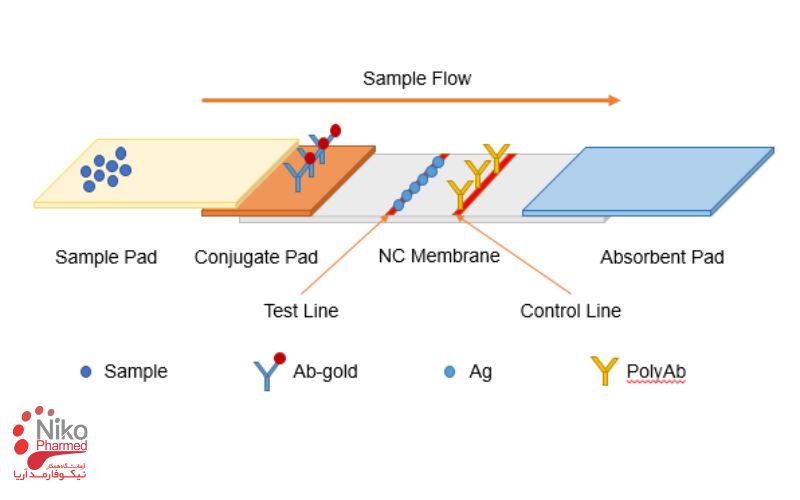
Two common methods for detection and quantification: HPLC: It is a high-performance liquid chromatography technique in which the purified solution is directly injected into the HPLC system, which has a column and a fluorescence or UV detector that separates and measures the concentration of each type of aflatoxin: B1, B2, G1, G2. ELISA is a simpler and more cost-effective screening method using antibodies specific to aflatoxins.
The intensity of color produced by the reaction in an ELISA indicates the level of aflatoxins present in a sample. Calculation & Interpretation of Results Results are expressed in ppb (parts per billion). These values are compared with the allowable limits set by standard organizations such as Codex or ISIRI. In case the level of aflatoxin is beyond the limit, the product is considered non-compliant. Reporting A report is generated that includes the sample type, test method, measured values, and final interpretation.
This report acts as the basis for decisions relating to the consumption, distribution, or disposal of the product.
How NikoPharmed Conducts Aflatoxin Testing
As a recognized and accredited laboratory, NikoPharmed carries out aflatoxin testing by using sophisticated equipment and following both national and international standards. Being equipped with appropriate, sensitive, and precise methods, NikoPharmed is able to detect and quantify a variety of aflatoxins. Given the commitment of this laboratory to high accuracy, quality control, and reliable results, it would be a sure place for carrying out this important test.
For a free consultation and services, contact NikoPharmed